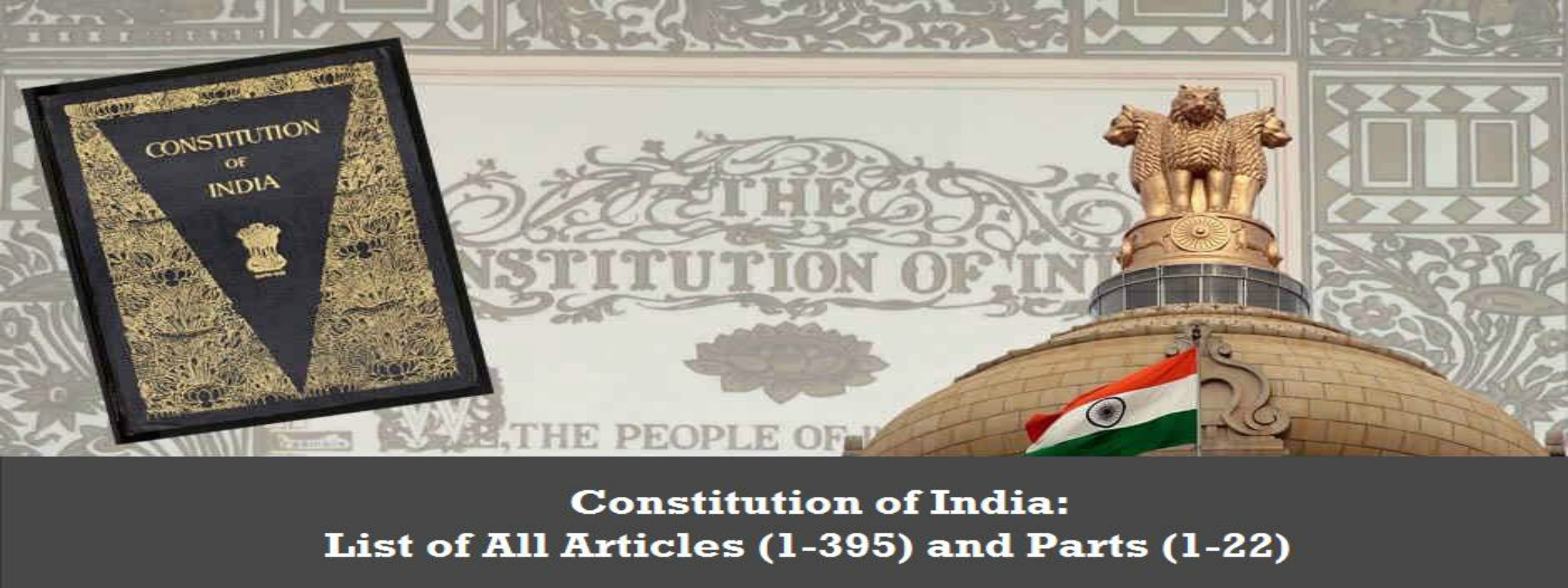
The Indian constitution is the world's longest. At its commencement, it had 395 articles in 22 parts and 8 schedules. It is made up of almost 80,000 words. In its current form (September 2012), it has a preamble, 25
The individual articles of the constitution are grouped together into the following parts:
with the words "socialist" and "secular" added to it in 1976 by the 42nd constitutional amendment .
|
|
Institutions of governance, such as the Parliament, the President, the Judiciary, the Executive, etc. did not exist before the adoption of the constitution, by the people of India, and were created by it. Prime Minister as the head of union cabinet which would aid and advice the President in performing his constitutional duty. Union cabinet is collectively responsible to the House of the People.
The Constitution of India is in nature but unitary in spirit. The common features of a federation such as written Constitution supremacy of Constitution, rigidity of Constitution, two government, division of powers bicameralism and independent judiciary as well as unitary features like single Constitution, single citizenship, integrated judiciary, flexible Constitution, a strong Centre appointment of by the Centre, All-India Services Emergency Provisions etc. can be seen in Indian Constitution. This unique combination makes it quasi-federal in form.
Each state and each Union territory of India has its own government. Analogous to President and Prime Minister, each has a Governor (in case of states) or Lieutenant Governor (in the case of Union territories) and a Chief Minister Article 356 permits the President to dismiss a state government and assume direct authority when a situation has arisen in which the Government of the State cannot be carried on in accordance with the provisions of the Constitution. This power, known as President's rule, was abused earlier as state governments came to be dismissed on the flimsiest of grounds, and more due to the political discomfiture of the party in power at the centre. Post – Bommai judgment referenc h such course of has been rendered rather difficult, as the courts have asserted their right to review it. Consequently, very few state governments have been disbanded since.
The 73rd and 74th Amendment Act also introduced the system of Panchayati Raj in rural areas and Municipality in urban areas. Also, Article 370 of the Constitution gives special status to the State of Jammu and Kashmir.